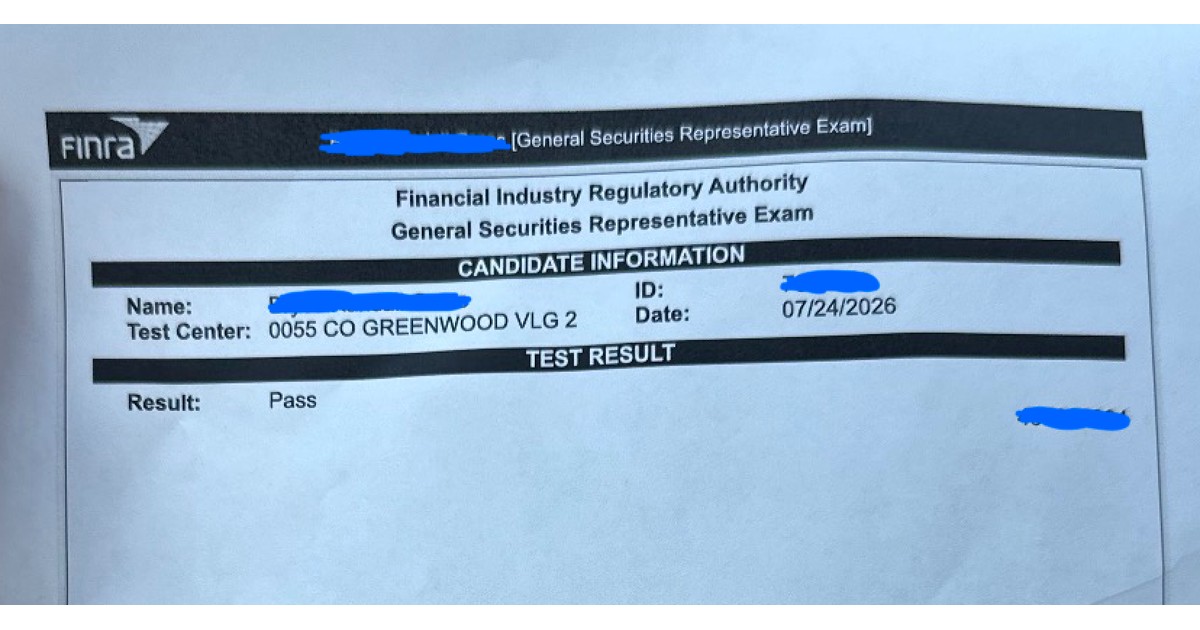
Another Exam Bootcamp student has officially recorded a Series 7 exam pass. The score report came back on July 24, 2026 with the only word that matters on test day: Pass.
This candidate prepared with two things working together — the Series 7 study guide and private Series 7 tutoring. That combination is worth breaking down, because it is the pattern behind most of the passes we see.
What the Series 7 Exam Actually Asks Of You
The Series 7 is officially the General Securities Representative Exam. It is the license that lets a representative work across a broad range of securities products, and it is the exam that decides a lot of careers in the industry.
According to FINRA, the exam is 125 multiple-choice questions, with a time limit of 3 hours and 45 minutes, and a passing score of 72. Those numbers matter less than what sits behind them. The Series 7 is not a memorization test. It asks whether you can read a fact pattern, work out what is actually being asked, and pick the best answer among options that all look defensible at a glance.
That is why candidates who know the material still miss questions. The gap is usually not knowledge. It is interpretation.
Study Guide First, Then Targeted Sessions
The study guide does the heavy lifting on structure. It covers the exam the way FINRA organizes it, so a candidate is not guessing at what is testable or wasting weeks on material that will never appear. Options, suitability, municipal securities, margin, bonds and yields, taxation, customer accounts — all of it mapped to the outline instead of an arbitrary reading order.
Private sessions do something the guide cannot. They find the specific reason a candidate is missing a specific question type. Two people can both score in the 60s on a practice exam for completely different reasons — one is misreading suitability fact patterns, the other is losing time on options and rushing the last forty questions. The fix is different for each, and it is very hard to diagnose alone.
Used together, the pattern looks like this: build the base with the guide, then use session time to correct what the practice scores expose.
Why the Combination Works
Most candidates who struggle with the Series 7 are not under-studying. They are studying without feedback. They read more pages, answer more questions, and repeat the same interpretation errors because nothing in the process points those errors out.
A session breaks that loop. Working through missed questions out loud surfaces the reasoning behind the wrong answer, and that reasoning is the thing that needs to change. Once a candidate can predict how a question is built — what the distractors are doing, which detail in the stem is decisive — accuracy moves across the whole exam, not just the topic being reviewed.
That is what happened here. A structured base, then focused correction, then a pass.
If You Are Preparing for the Series 7
A few things are worth knowing before you start, whether this is a first attempt or a retake:
- Practice scores in the 60s are a signal about how you are reading questions, not a verdict on whether you can pass.
- Options and suitability carry weight far beyond the number of questions they represent, because the reasoning transfers everywhere.
- Time management is a skill you practice, not something that sorts itself out on exam day.
- A retake is not a restart. What you already know still counts — the approach is what needs adjusting.
If you want to understand the exam itself first, start with the Series 7 format and topic breakdown or what the passing score of 72 really requires.
If you already know where you are losing points and want them fixed, that is what one-on-one Series 7 help is built for. And if you are starting from the beginning, the Series 7 study guide and question bank is the base to build on.
Congratulations to this candidate. Passed on the day that counted.