
Section 1 — 16% (12 questions)
Knowledge of Capital Markets
- Regulators & Industry Players
- Capital Markets & How Securities Trade
- Offerings & the New Issue Process
Prep for the Securities Industry Essentials Exam with a clear study guide, exam-style practice questions, and progress tracking. Self-paced online prep built for passing—simple explanations, targeted quizzes, and full-length practice exams so you always know what to study next.
Instant digital access • Mobile + desktop friendly • Progress tracking • Built for exam-style testing
The Securities Industry Essentials exam is FINRA’s entry-level securities exam. It tests baseline industry knowledge: how capital markets work, the products that trade in them and their risks, how trading and customer accounts operate, what conduct is prohibited, and how the regulatory framework fits together. Because no sponsorship is required, it’s the one securities exam you can take entirely on your own — before you have a job offer, while you’re still in school, or while you’re interviewing.
Passing the SIE does not register you with FINRA or qualify you to sell securities. On its own, it doesn’t let you work with customers, accept orders, or earn commissions. To become registered, you also need a firm to sponsor you and you must pass a representative-level “top-off” exam for your role — most commonly the Series 7 for general securities or the Series 6 for investment company and variable products. What the SIE does do is cut the top-off exam down to role-specific material, and signal to hiring firms that you can pass a FINRA exam before they spend a sponsorship on you.
Four sections, weighted by FINRA. Products and their risks is nearly half the exam — weight your study time accordingly.
Section 1 — 16% (12 questions)
Section 2 — 44% (33 questions)
Section 3 — 31% (23 questions)
Section 4 — 9% (7 questions)
The SIE is an entry-level exam, but it isn’t a giveaway. It covers a wide range of vocabulary and concepts — dozens of product types, order types, account rules, and regulations — and most people taking it are seeing this material for the first time. FINRA does not publish official pass rates, so be skeptical of any prep provider quoting one. In our experience the students who struggle are the ones who read passively and skip question practice; the ones who pass comfortably treat practice questions as the core of their prep, not a final check.
The questions themselves are mostly definitional and conceptual, with some scenario-style application. The challenge is breadth, not depth: you don’t need to master options math the way a Series 7 candidate does, but you do need working recall across the whole outline.
If you’re already associated with a member firm, the firm can open the enrollment window for you instead through its own filing process. Either way, the exam content and passing standard are identical.
The SIE tests general industry knowledge; the Series 7 tests whether you can do the job of a general securities representative. The Series 7 is longer (125 scored questions over 3 hours 45 minutes vs. 75 scored in 1 hour 45), requires firm sponsorship, and goes far deeper on options strategies, suitability, margin, and taxation. Think of the SIE as the vocabulary and the Series 7 as the fluency test. You need both, plus sponsorship, to register as a general securities rep.
The Series 6 is the narrower top-off: it registers you for investment company products (mutual funds) and variable contracts, not individual stocks and bonds. If your role is at an insurance company or a bank program selling funds and annuities, the SIE + Series 6 path is usually the requirement. If you’ll handle general brokerage business, it’s SIE + Series 7.
Original questions written by our instructors in the style of the exam — not taken from our question bank or any other provider.
1. An investor buys a corporate bond with a 5% coupon at a price of 102. If market interest rates rise significantly after the purchase, the market price of the bond will most likely:
Answer: A. Bond prices and market interest rates move inversely. When rates rise, existing bonds with lower fixed coupons become less attractive, so their market prices fall. The fixed coupon determines the income the bond pays, not the direction its price moves.
2. Which of the following orders guarantees that a trade will be executed but does NOT guarantee the price?
Answer: B. A market order executes immediately at the best available price — execution is certain, price is not. A limit order is the reverse: it guarantees a price boundary but may never execute if the market doesn’t reach it.
3. A shareholder of XYZ common stock wants to keep the same percentage ownership when XYZ issues additional shares. Which feature of common stock ownership makes that possible?
Answer: B. The preemptive right lets existing shareholders buy new shares — typically through a rights offering — before the public, in proportion to what they already own, protecting them from dilution. Voting method affects board elections, not ownership percentage.
4. Which of the following actions by a registered representative is a prohibited activity?
Answer: C. Trading ahead of a customer order to profit from its expected market impact is front-running, a prohibited activity. The other choices describe normal, compliant order handling.
Read the chapter, take the quiz, review every explanation, then simulate the real exam with full-length finals — repeating weak areas until your scores stabilize.
Screenshots shared by Exam Bootcamp students
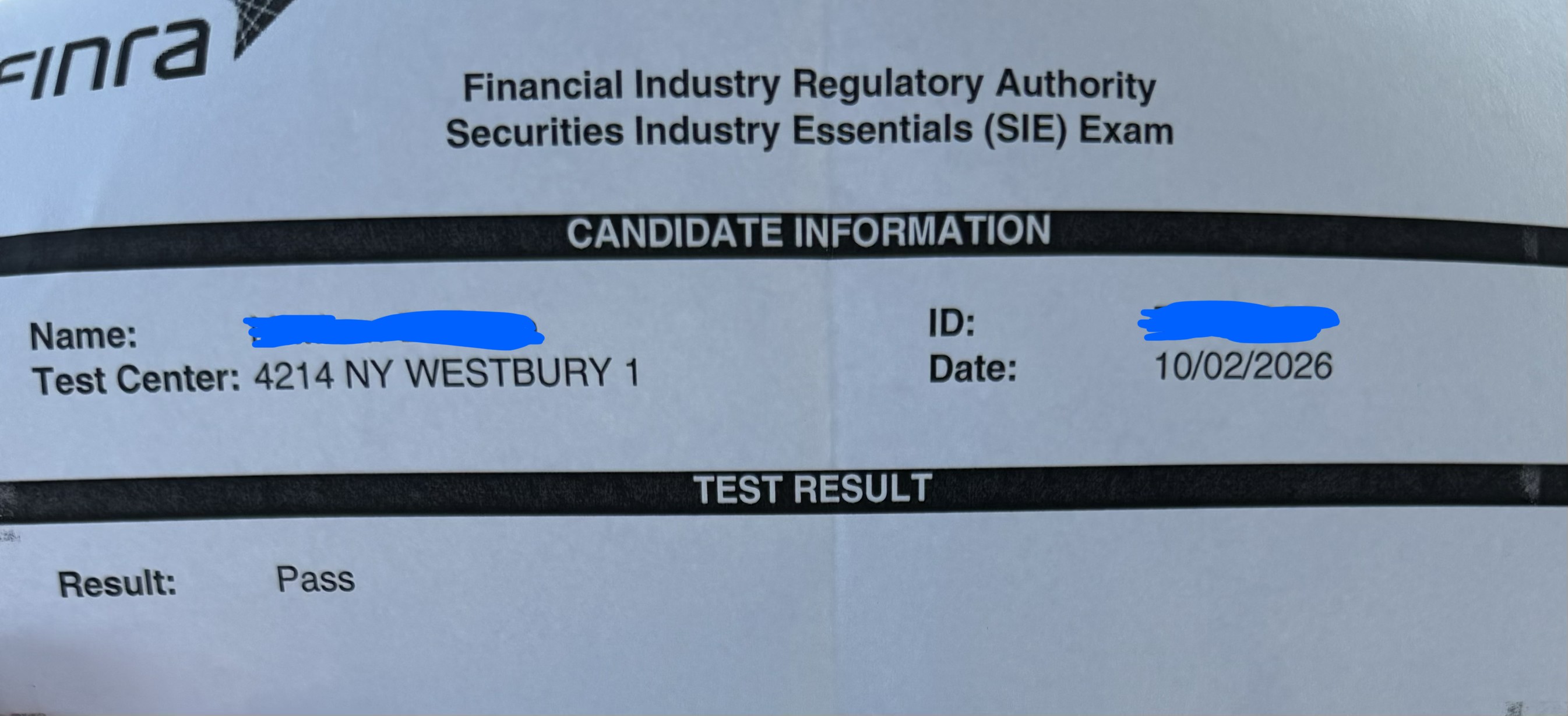
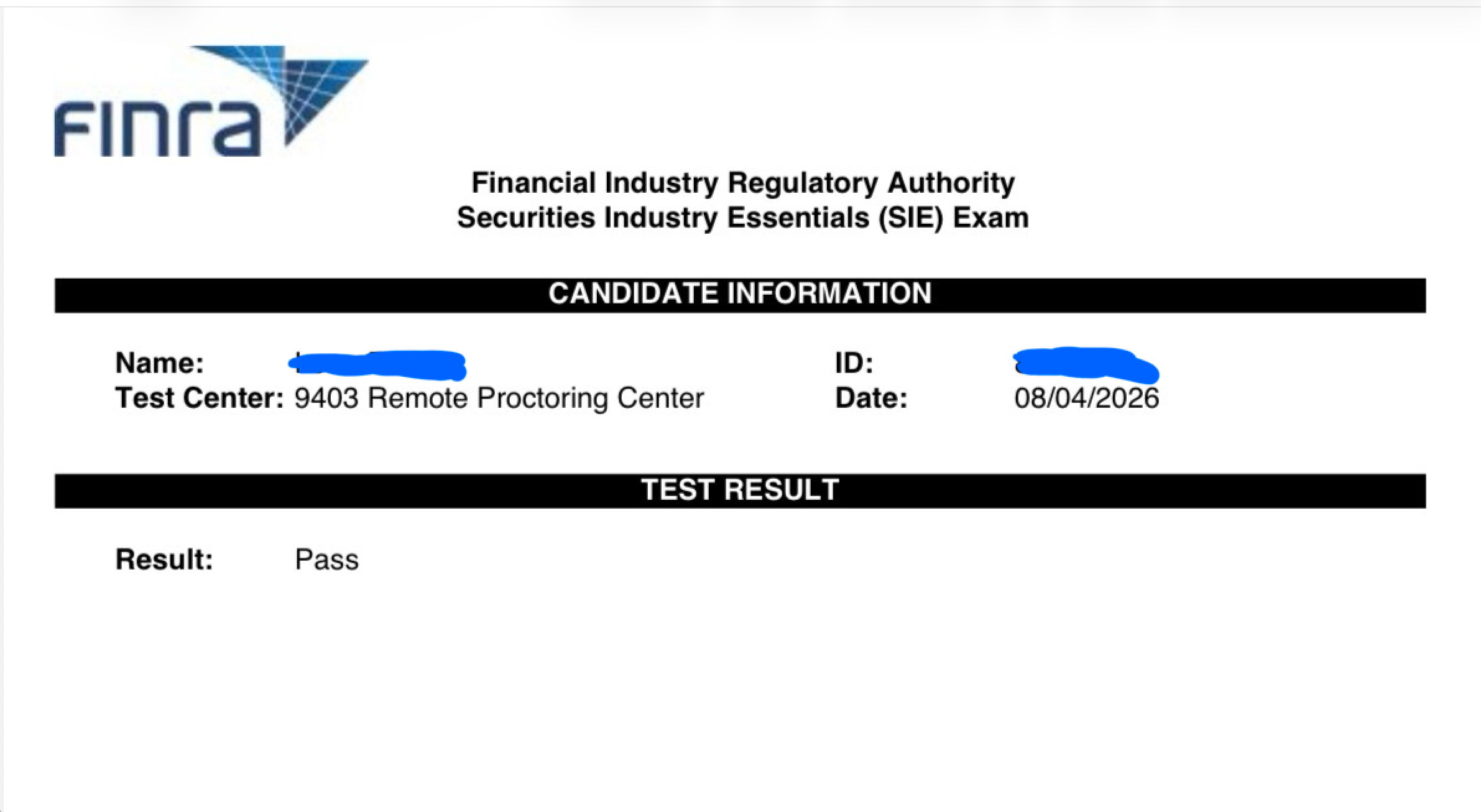
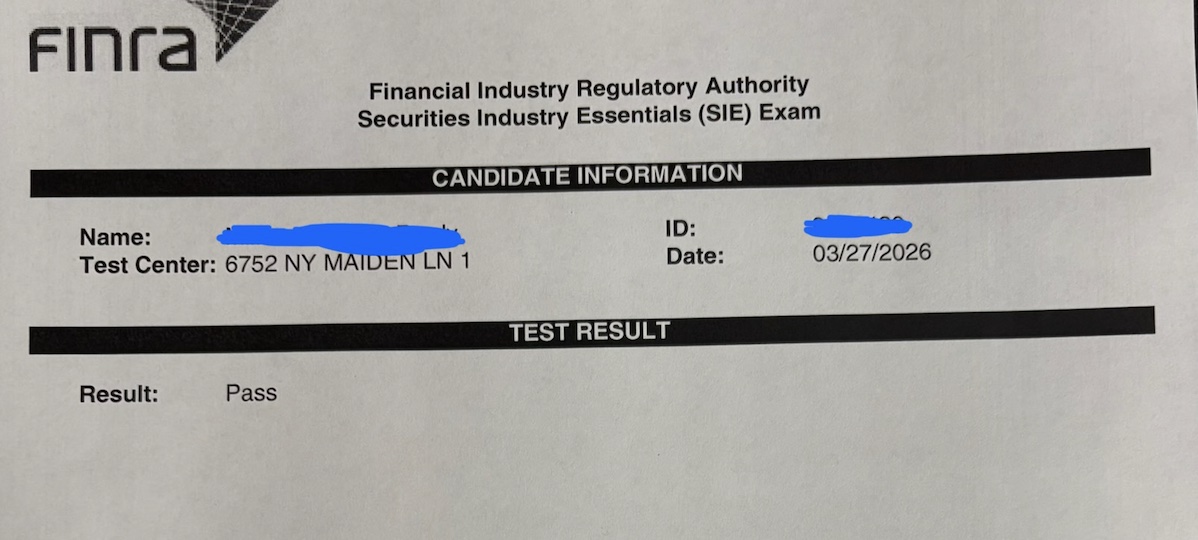
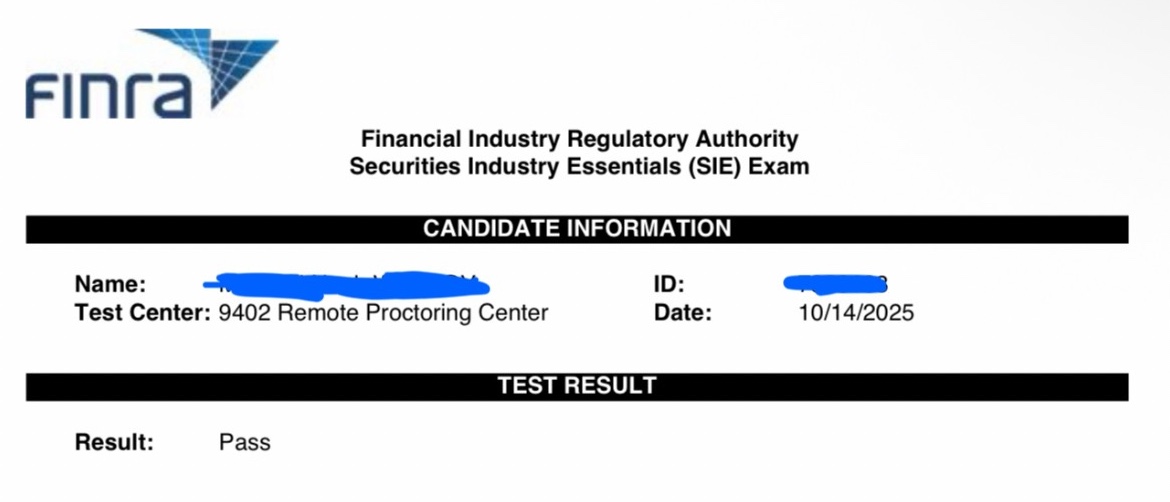
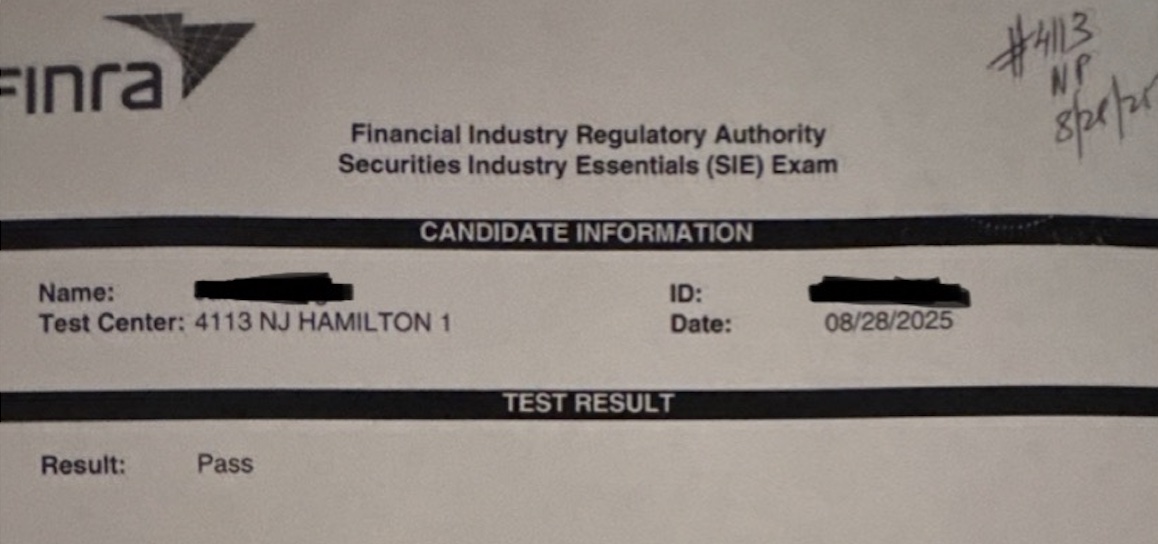
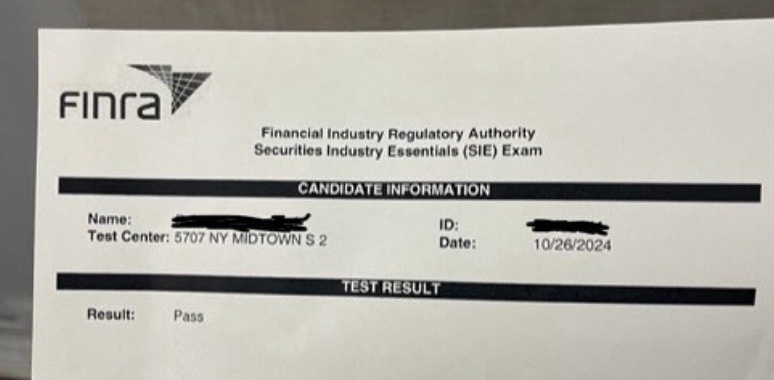
Passed the SIE on my first try after getting a tailored study plan and targeted drills on weak areas. Clear explanations and great support.
— Matt T, SIE
After struggling with the SIE, the concepts finally clicked and I passed. Continued into Series 7 prep and passed with stronger test strategy.
— Graham, SIE
Jason is great. He woke up early to tutor me before work and made the material much easier to understand. I passed my SIE from working with him and then continued working with him for my Series 7 and Series 63. He created a study plan and showed me how to use all the resources so I had as much exposure as possible. I highly recommend Jason for all of your studying needs.
— Millie, SIE
GET INSTANT ACCESS
$79.99
Sources: FINRA — Securities Industry Essentials (SIE) Exam · FINRA — Enroll for the SIE · FINRA Rule 1210 (registration requirements)
Content reviewed against the official FINRA outline in July 2026.
Most people sitting the SIE take at least one of these, either before it or straight after. Each guide is a separate product with its own question bank.
Want it taught rather than read? See SIE tutoring, or browse all securities exam study guides and live exam bootcamps.
Get instant access to the SIE Study Guide and start practicing with exam-style questions now.
Get Instant Access — $79.99