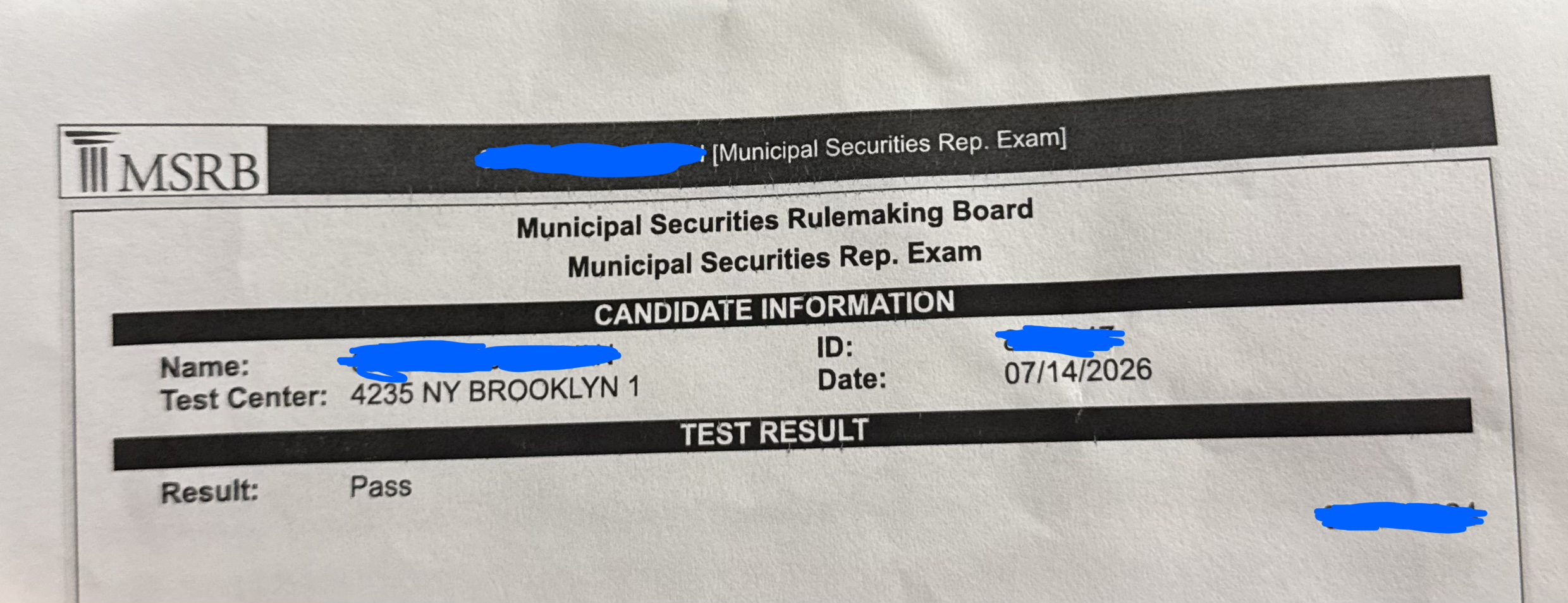
Another Series 52 exam pass just landed — this one at the NY Brooklyn test center, dated July 2026. The student ran the combo we recommend for the muni exam: our study guide and question bank to build the base, plus private sessions to close the gaps that were quietly costing points. Here's exactly what we worked on and how you can run the same playbook.
What makes the Series 52 exam different
The Series 52 is developed and owned by the MSRB, not FINRA, even though you sit for it through the same testing system as every other license. That single fact shapes the whole exam: 75 scored questions in two and a half hours, a 70% passing bar, and a content mix that leans hard on municipal bond structure, real bond math, and the MSRB G-rules rather than the general FINRA conduct rules you saw on the SIE. Study for it like a generic securities exam and you leave points on the table. The MSRB's official Series 52 page lays out the topic weighting if you want to confirm the current spec before you schedule.
Where this student was losing points
The pattern was one we see constantly on the muni exam: comfortable talking about bonds in general, but shaky on the two things that actually decide the Series 52 — the math and the G-rules. Accrued interest, yield-to-call versus yield-to-maturity, and tax-equivalent yield all felt slow and uncertain under the clock. And the MSRB rules read like a wall of memorization: gift limits, political-contribution restrictions, confirmation and recordkeeping requirements, all blurring together. Practice scores were stuck just under the line, which almost always means one or two sections are dragging the whole average down.
What we fixed in private sessions
The bond math, drilled until it was automatic. We didn't add material — we made the handful of calculations that show up again and again reflexive. Accrued interest, YTC vs. YTM, and tax-equivalent yield turned into free points instead of time sinks, which is exactly what they should be once the mechanics are second nature.
The G-rules became patterns, not lists. Instead of memorizing MSRB rules cold, we grouped them by what problem each one solves — fair dealing, disclosure, gifts and contributions, recordkeeping. Once the student could see which rule governs which behavior, the conduct questions stopped feeling like coin flips.
Mixed, timed practice that mirrored the real thing. The Series 52 makes you change gears between bond math and rule recall on the fly, so we drilled mixed sets on the clock. By test day the format was old news and the exam felt easier than practice.
The result
A clean pass on test day, July 2026. The part the student had dreaded — the MSRB rules — ended up feeling manageable because it finally had a structure. That's the whole value of one-on-one work: we find the specific thing standing between you and a pass and remove it, instead of handing you a generic course and hoping it lands.
How to pass the Series 52 exam yourself
Be honest about which side is weaker — the muni bond math or the MSRB rules — and put your hours there first. Drill the calculations until they're reflexive, learn the G-rules as patterns instead of flashcard lists, and practice mixed sets under time before test day. Our Series 52 study guide and question bank is built around exactly that method: teach the concept plainly, drill it with exam-style questions, and explain why each wrong answer is wrong. If you want the same targeted help this student had, our private sessions build the prep around you — we find what's actually costing you points and get you to a pass. You can also see every exam we prep for on the bootcamps page. Book a private session and let's get your Series 52 done.