
Series 65 Study Guide + Question Bank

Series 65 Study Guide + Question Bank (Online)

Prep for the NASAA Series 65 - Uniform Investment Adviser Law Exam with 1,230+ exam-style questions, chapter quizzes, mini exams, and full-length practice finals. Self-paced online prep covering investment adviser law, ethics, client strategies, investment vehicles, and economic factors.

Instant digital access • Mobile + desktop friendly • Progress tracking • Built for exam-style testing

The Series 65 exam at a glance

Format details from the official NASAA and FINRA exam pages.
AdministratorNASAA exam, delivered through FINRA’s test system at Prometric
Prerequisite / sponsorshipNone — no firm sponsorship and no other exam required; individuals self-enroll with Form U10 (firms may file Form U4)
Questions140 total — 130 scored + 10 unscored pretest questions
Time limit180 minutes (3 hours)
Passing score92 of 130 scored questions (about 70.8%)
DeliveryPrometric test centers or online proctored testing
Retake waiting periods30 days after a first or second failed attempt; 180 days after a third or subsequent failed attempt

What the Series 65 is — and what an IAR can actually do

The Series 65 — the Uniform Investment Adviser Law Examination — is NASAA’s qualification exam for investment adviser representatives (IARs). Passing it is how you qualify to give investment advice for compensation at the state level: building financial plans, recommending portfolios, and charging fees for advice rather than earning commissions on trades. It’s the standard credential for fee-only advisers, and a common path for career changers, insurance professionals adding advisory work, and brokers moving to the RIA channel.

Passing the exam is not the same as being registered. A passing Series 65 qualifies you to apply; you become an IAR only when a state approves your registration, normally with you associated with a registered investment adviser (RIA) firm. Until then, you cannot hold yourself out as an adviser or charge for advice. Also note what the 65 doesn’t cover: it does not license you to sell securities products for commissions — that’s broker-dealer territory and requires the SIE plus a rep-level exam like the Series 7.

What's on the Series 65: the official content outline

Organized to match how the Series 65 is structured - economics and products first, then client strategies, with heavy focus on investment adviser law, fiduciary duty, and ethics. Functions 3 and 4 are 60% of the exam combined.

Function 1 - 15% (20 questions)

Economic Factors and Business Information

  • Monetary & fiscal policy, economic indicators, business cycles
  • Financial reporting & accounting fundamentals
  • Quantitative methods / time value of money
  • Types of risk - systematic, unsystematic, inflation, interest rate, credit, liquidity
Function 2 - 25% (32 questions)

Investment Vehicle Characteristics

  • Cash & equivalents
  • Fixed income & valuation - YTM, YTC, duration concepts
  • Equities & equity valuation
  • Pooled investments - mutual funds, ETFs, UITs, REITs
  • Derivatives & alternatives
  • Insurance-based products - annuities, life

Function 3 - 30% (39 questions)

Client Investment Recommendations and Strategies

  • Individuals, business entities & trusts
  • Client profiles - goals, risk tolerance, time horizon
  • Capital market theory - CAPM, MPT, EMH
  • Portfolio management styles, strategies & techniques
  • Tax considerations
  • Retirement & estate planning, ERISA
  • Special accounts
  • Trading, exchanges & markets
  • Performance measurement

Function 4 - 30% (39 questions)

Laws, Regulations and Guidelines (incl. Prohibited Practices)

  • Investment Advisers Act & state law
  • IA / IAR registration, Form ADV
  • Federal vs. state (covered advisers)
  • USA definitions & exemptions
  • State Administrator authority & remedies
  • Fiduciary duty, custody, soft dollars, performance fees
  • Ethical practices, insider trading, market manipulation
  • AML/BSA/privacy/cybersecurity
  • NASAA Model Acts & Statements of Policy

How hard is the Series 65?

Candidates regularly underestimate the Series 65 because it has no prerequisite. In practice it’s a dense exam: the law and ethics function alone spans two federal acts, the Uniform Securities Act, NASAA model rules, and a long list of prohibited practices — and it’s tested with precise, lawyer-ish wording where one word (“solicit,” “custody,” “person”) changes the answer. The investments half of the exam adds real math: time value of money, yields, and portfolio statistics like beta, alpha, and standard deviation. NASAA does not publish official pass rates, so treat any quoted number as marketing.

The good news: the exam is very learnable with structured repetition. Definitions and exemptions reward flashcard-style drilling, and the scenario questions repeat a manageable set of patterns — registration triggers, de minimis counts, fiduciary conflicts, and suitability by client profile.

How long should you study?

  • No financial background: 6–9 weeks at about an hour a day. Split time evenly between the law (Function 4) and the investments/economics material, and start scenario practice by week two.
  • Coming from insurance or banking: 4–6 weeks. The product knowledge transfers; the USA definitions, Administrator powers, and Form ADV mechanics will be new and are heavily tested.
  • Already hold the Series 7: 3–5 weeks. You know the products; focus almost entirely on adviser law, fiduciary standards, and the quantitative methods the 7 doesn’t test. (If you hold an active 7, also weigh the Series 66 instead — see the comparison below.)
  • Retaking after a fail: use the 30-day wait to rebuild your two weakest functions with the chapter quizzes, then confirm with a timed full final. If law questions are the recurring problem, a 1-on-1 private session focused on USA definitions usually pays for itself.

How to register and schedule the Series 65

  1. If you’re not with a firm, self-enroll by filing Form U10 and paying the exam fee. If you’re joining an RIA or broker-dealer, the firm opens your window with Form U4.
  2. Once the 120-day enrollment window opens, schedule with Prometric — test center or online proctored.
  3. Take the exam; you’ll receive your result at the end of the session.
  4. After passing, complete state IAR registration through your firm (or when you affiliate with one). Most states expect registration within two years of passing, after which the result goes stale.

Series 65 vs. 66, 63, and 7

Do I need the Series 7 first?

No. The Series 65 stands entirely alone — no SIE, no Series 7, no sponsorship. That’s the key structural difference from the Series 66, which does require the Series 7 as a corequisite.

Series 65 vs. Series 66

The 66 combines the Series 63 (state agent law) and the Series 65 (adviser law) into one exam for people who are also Series 7-registered reps. If you work at a broker-dealer and need both agent and IAR status, 7 + 66 is the efficient path. If you only need IAR status — fee-only planning, RIA work, no commission business — the 65 alone is the right exam.

Series 65 vs. Series 63

The Series 63 registers securities agents (commission sales) at the state level and pairs with the Series 7 or 6. It does not qualify anyone to charge for advice. The 65 is the advice-side license; the 63 is the sales-side one. Many careers eventually involve both, but they answer different regulatory questions.

Series 65 vs. Series 7

The Series 7 is a FINRA exam for selling securities through a broker-dealer, requires sponsorship, and leans hard into products, options, and trading. The 65 is a NASAA law exam about giving advice as a fiduciary. They overlap on product basics, but the 65’s center of gravity — the Investment Advisers Act, the USA, and fiduciary conduct — barely appears on the 7.

Sample Series 65 practice questions

Original questions written by our instructors in the style of the exam — not taken from our question bank or any other provider.

1. Under the Uniform Securities Act, which of the following is excluded from the definition of "investment adviser"?

  1. A firm that manages portfolios for retail clients for an asset-based fee
  2. A bank that provides investment advice through its trust department
  3. A financial planner who charges a flat fee for comprehensive investment advice
  4. A person who issues paid subscription reports recommending specific securities based on each subscriber’s situation
Show answer & explanation

Answer: B. Banks (and savings institutions and trust companies) are excluded from the USA’s definition of investment adviser. The other three are squarely in the definition: they provide advice about securities, for compensation, as part of a business.

2. An investment adviser representative works for a federal covered adviser and has no place of business in State B. Over the past 12 months she has 4 individual (retail) clients who are residents of State B. Under the Uniform Securities Act, she is:

  1. Required to register in State B as an IAR
  2. Not required to register in State B under the de minimis exemption
  3. Required to register only if her clients are accredited investors
  4. Prohibited from serving residents of State B
Show answer & explanation

Answer: B. The de minimis exemption applies when a person has no place of business in the state and no more than 5 retail clients resident there within the preceding 12 months. With 4 clients and no in-state office, no State B registration is required.

3. A client’s portfolio has a beta of 1.2. If the overall market rises 10%, the portfolio would be expected to:

  1. Rise about 8.3%
  2. Rise about 10%
  3. Rise about 12%
  4. Fall about 12%
Show answer & explanation

Answer: C. Beta measures sensitivity to market movement. A beta of 1.2 means the portfolio is expected to move 1.2× the market: 10% × 1.2 = 12%. Beta cuts both ways — the same portfolio would be expected to lose about 12% in a 10% market decline.

4. Which of the following risks CANNOT be reduced through diversification across many securities?

  1. Business risk
  2. Market risk
  3. Default risk of a single issuer
  4. Regulatory risk affecting one industry
Show answer & explanation

Answer: B. Market (systematic) risk affects the entire market and remains no matter how many securities you hold. Diversification addresses unsystematic risks — those tied to a specific company or industry, like business risk, single-issuer default, or industry regulation.

How the Exam Bootcamp system works

Every chapter gets a Learn, Apply, and Master quiz — definitions first, scenarios second, exam-level difficulty third — before you graduate to timed mini exams and three full 130-question finals.

What you get with the Series 65 Study Guide — $94.99

  • 1,230+ exam-style practice questions across the full Series 65 outline
  • 23 chapters mapped to the NASAA Series 65 content outline
  • 69 chapter quizzes - Learn (10 Qs), Apply (10 Qs), and Master (10 Qs) for every chapter
  • 3 Mini Exams (50 questions each) for timed practice
  • 4 full-length Final Practice Exams (130 questions each) matching exam length and structure
  • Heavy coverage of laws, regulations, and ethics plus client recommendations (60% of the exam combined)
  • Full coverage of investment vehicles and economic factors
  • Progress tracking by chapter and difficulty to target weak areas fast
  • Clear explanations focused on what NASAA actually tests
  • Self-paced online prep, mobile + desktop friendly

Results from real students

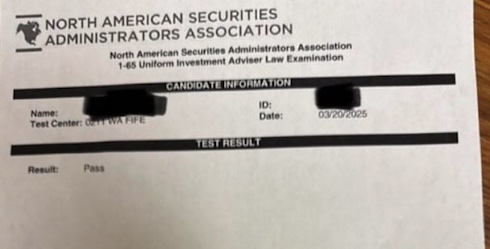
Screenshots shared by Exam Bootcamp students.

Series 65 pass resultSeries 65 pass result

What students say

Jason helped me pass my Series 65. He knows the material very well and always knew the answers to my questions. Jason worked around my schedule and made time for sessions. He does the research and gives you what you need to know regarding each topic. He was always willing to answer questions and help outside of sessions as well. I definitely recommend Jason to anyone looking to pass their Series 65.

Kaleigh, Series 65

I recently worked with Jason to prepare for the Series 65 exam and could not be more satisfied. From the first lesson, Jason demonstrated a deep understanding of the material, breaking down complex topics like investment strategies, economics, and regulations into easily digestible pieces. The tutoring sessions were tailored to my specific needs, with a strong focus on areas where I needed the most improvement. I appreciated Jason’s patience and ability to explain difficult concepts in multiple ways until I truly understood them. Beyond technical knowledge, Jason provided valuable tips on time management, test-taking strategies, and staying calm under pressure. Thanks to his thorough and focused approach, I was ready for the Series 65 exam and passed on my first attempt.

Will, Series 65

GET INSTANT ACCESS

Series 65 Study Guide + Question Bank

$94.99

  • Includes: Online study material + 1,230+ question bank + 3 mini exams + 4 full-length practice finals
  • Access: 6 month access to the study material
  • Start studying immediately after purchase - no waiting.

Frequently asked questions

  • You'll have access for 6 months starting immediately after purchase.

Sources: NASAA — Series 65 Exam · FINRA — Series 65 exam page · NASAA — Exam FAQs

Content reviewed against the official NASAA outline in July 2026.

Ready to start passing prep today?

Get instant access to the Series 65 Study Guide and start practicing with exam-style questions now.

Get Instant Access - $94.99