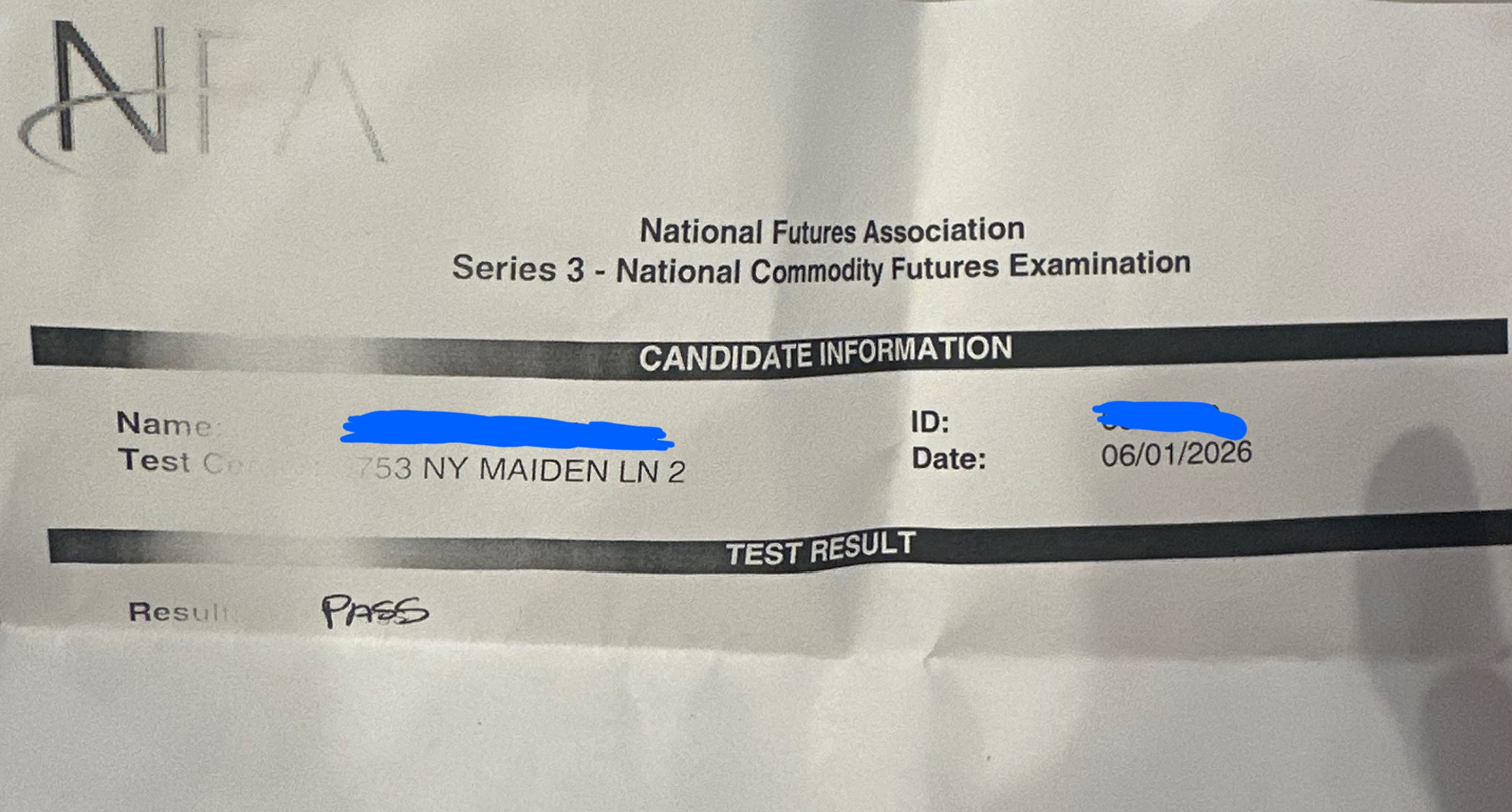
Another Series 3 pass is in the books. This one came through Exam Bootcamp private sessions — a student who went from "the futures math is not clicking" to a clean PASS on the National Commodity Futures Examination. Here's what we worked on and how you can run the same playbook.
What the Series 3 exam actually is
The Series 3 is administered by the National Futures Association (NFA) — not FINRA — and it's the license for anyone soliciting or accepting orders for futures and commodity options. As of mid-2026 the exam runs 120 scored multiple-choice questions split across two parts: a market-knowledge part covering futures fundamentals, hedging, spreads, options on futures, and margin, and a regulations part covering the rules that govern the industry. You need a passing score on both parts in the same sitting, and the regulations part trips up more candidates than the math does.
That split is the whole strategy. Plenty of people over-study the calculations and walk in shaky on regulations, or the reverse. You have to be solid on both at once.
Where this student was stuck
When we started private sessions, the pattern was familiar: comfortable reading charts and talking markets, but losing points on the mechanical stuff — basis and the relationship between cash and futures prices, long vs. short hedges, and option premium math under time pressure. On the regulations side, the rules felt like a wall of memorization with no structure.
So we didn't add more content. We fixed the approach.
What we focused on in private sessions
The futures math, drilled until it was automatic. We hammered the handful of calculations that show up again and again — hedging outcomes, basis changes, spread gains and losses, and option premium math — until the student could set them up without thinking. The Series 3 doesn't reward clever; it rewards fast and certain.
Regulations turned into patterns, not lists. Instead of memorizing rules cold, we grouped them by who they protect and what problem they solve. Registration, disclosure, recordkeeping, and prohibited conduct each have an underlying logic, and once the student saw the logic, the answers stopped feeling like guesses.
Timed practice that mirrored the real split. We practiced both parts together, on the clock, so the test-day format was old news. The goal was to make the actual exam feel easier than practice — and it did.
The result
A pass on test day, dated June 2026. The student walked out saying the regulations part — the part they'd dreaded — felt manageable because it finally had a structure. That's the whole point of working one-on-one: we find the specific thing in your way and remove it, instead of throwing a generic course at you.
How to run the same playbook
If you're prepping for the Series 3, start by being honest about which side you're weaker on — the market math or the regulations — and put your time there. Drill the calculations until they're reflexive, learn the rules as patterns rather than lists, and practice both parts under time before test day.
Our Series 3 study guide is built around exactly that approach — mechanism-first explanations and a question bank that mirrors the real exam split, so you can find your weak spots and close them. And if you want the same one-on-one attention this student had, our private sessions let us build the prep around you: we target what's actually costing you points and get you to a pass. Book a private session and let's get your Series 3 done.